
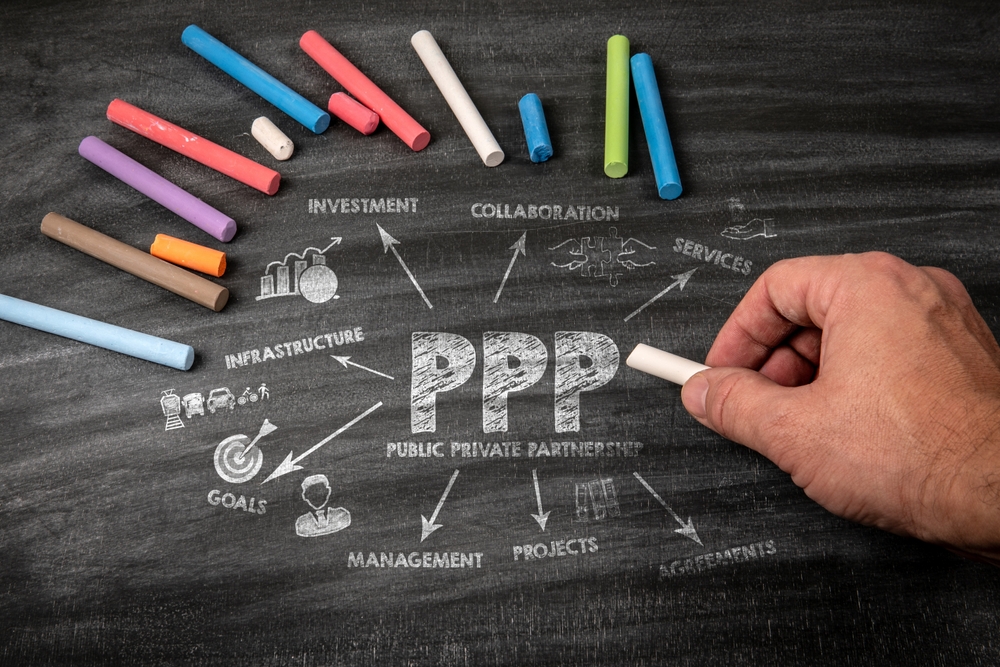
Public-private partnership (PPP) is a form of cooperation between public administrations and private operators for the implementation of infrastructure projects and the provision of services of collective interest, combining financial resources, technical skills and management capabilities of both parties. This tool allows for the activation of alternative sources of financing compared to traditional public channels and to benefit from the specialized know-how of private operators, with the aim of making the processes of implementation of strategic works, such as roads, hospitals, energy plants and, in general, all those infrastructures that significantly impact the economic and social development of the country, more efficient and rapid. In this context, the sector legislation aims to ensure that the private entity actually assumes the technical and financial risks associated with the initiative and, at the same time, ensures the protection of the general interest through criteria of transparency, competitiveness and correct contractual balance.
On 31 December 2024, Legislative Decree no. 209/2024, the so-called “corrective decree”, entered into force, integrating and amending the Public Contracts Code referred to in Legislative Decree no. 36/2023.
With reference to the instruments of public-private partnership, the legislative intervention concerned, in particular, project financing which finds its regulation in Article 193 of the Code, subject to a profound revision in order to increase its transparency, competition and coherence with national infrastructure plans. The new discipline of project financing, on the one hand, responds to the needs of reorganization and improvement of the previous one emerged from administrative practices and, on the other hand, welcomes the recommendations of the European Institutions and the Council of State, which have underlined the need to strengthen the rules of selection, evaluation and monitoring of the award procedures that involve the participation of private capital.
In the new text of Article 193, project financing is outlined as a model to be used no longer exclusively for interventions already included in the agency's programming tools, but also for additional initiatives proposed by private operators and for which the administration deems there is a public interest in their implementation. In practice, the operator is allowed to present an expression of interest, simultaneously requesting the administration for the data and information necessary for the preparation of a proposal. If the agency positively evaluates the prospect of developing the proposed work or service, it is required to give wide visibility to the initiative on its institutional website so that other potential operators can also become aware of the data transmitted and, if necessary, formulate their own proposals for improvement or alternatives. The obligation to publish in full the documentation sent to the so-called "promoter" represents a significant innovation for the project financing system, since it aims to avoid situations of information asymmetry and to promote effective competition, in line with the principles of equal treatment and non-discrimination typical of public contracts.
Similarly, even when an operator presents a feasibility project complete with economic-financial plan and draft agreement, the administration is required to verify the compatibility with the planning of the public-private partnership and the actual usefulness of the intervention proposed by the private individual, but the obligation to advertise is limited to the presentation of the proposal, without disclosing the project data. This approach aims to prevent competing operators from taking advantage of the intellectual work of the promoter, thus avoiding the disclosure of projects that could be easily imitated or reworked without having sustained the initial costs. From this perspective, the new discipline of project financing reaches a point of balance between the guarantee of free competition and the position of the promoter, who has undertaken the initiative by facing a significant project and financial commitment.
In the following sixty days from the presentation of the proposal, other operators possibly interested can submit alternative proposals to the administration, among which, in the following forty-five days, the project to be put out to tender will be selected on the basis of a comparative evaluation. Paragraph 5 of Article 193 reiterates, in fact, the need for the granting body to establish objective and predetermined criteria to measure the feasibility and the economic-financial value of each proposal received, in line with the principles of transparency and accountability that administrative action must be inspired by. This approach is also linked to the provision of Article 174 of the Code, which underlines how the allocation of operational risk (especially in public-private partnership contracts) must remain with the private operator, avoiding forms of excessive public protection that would end up distorting the very purpose of the PPP.
In addition, the new text of Article 193 consolidates the coordination with Article 175 of the Code which regulates the three-year planning of public needs and the preliminary analysis of convenience in the choice of a PPP instrument.
The corrective decree insists on the importance of an accurate investigation phase so that the administrations rigorously evaluate the economic and feasibility components of the project, to avoid overestimating the value of the investment or minimizing the construction and demand risks. To this end, the responsibility of the Sole Project Manager (RUP), charged with monitoring the activity from both a technical and financial perspective, is expanded and the verification activity carried out by the Department for Economic Policy Programming and Coordination (DIPE) and the State General Accounting Office is strengthened, which also thanks to a dedicated portal monitor the correct management of PPP contracts, ensuring the traceability of the key elements (CUP, CIG, overall value and duration).
Finally, a particularly debated aspect concerns the reform of paragraph 12 of article 193 regarding pre-emption.
Previously, the right to take over from the successful tenderer belonged exclusively to the promoter, recognizing him in a position of advantage for having borne the initial costs of developing the project. The corrective decree chooses, instead, to extend the pre-emption also to the proposing operators who have presented projects admitted to the comparative selection. Specifically, in the event of failure to exercise the pre-emption, the successful tenderer must reimburse the promoter or proposers for the expenses incurred for the conception of the project within the limit of 2.5% of the value of the intervention. If, however, the promoter or proposers decide to avail themselves of the pre-emption, they must take on the same contractual conditions proposed by the successful tenderer and, at the same time, reimburse the latter for the expenses incurred, always within the limit of 2.5%.
This solution, although aiming to balance the protection of those who bear the initial costs and to prevent the formation of de facto monopolies, raises strong doubts because it risks compromising the attractiveness of project financing, discouraging private operators from proposing new initiatives for fear of a limited economic recovery in the event of failure to award the contract.
Overall, the entire operation of rewriting Article 193 and, more generally, the rules on public-private partnerships, is part of a unitary vision of the Public Contracts Code that gives considerable importance to administrative efficiency, project quality and transparency of procedures. Articles 174 and 175 of the Code, which establish the general principles on PPP and planning of public needs, as well as the provisions on the qualification of granting bodies dictated by Article 63, aim to consolidate the professionalism of contracting authorities, to promote a more homogeneous management of complex contracts and to contain disputes.
If the new regulatory framework were to result in a significant increase in private initiatives and an improvement in the quality of proposals, in harmony with the objectives of collective interest, it could be considered that the PPP reform has achieved the objective of making project financing a truly effective pillar for the infrastructural development of the country and for the strengthening of essential public services.
The final outcome will also depend on administrative jurisprudence, which is called upon to interpret and apply the new legislation in a coherent manner, solving any interpretative issues and resolving any uncertainties that may arise in practice.